

Lack of empowered middle management can bring entire companies down. Take the recent operational crisis at IndiGo, for example. The warning signs and potential mitigation mechanisms were visible to middle management well before the crisis unfolded — but only if leadership had listened.
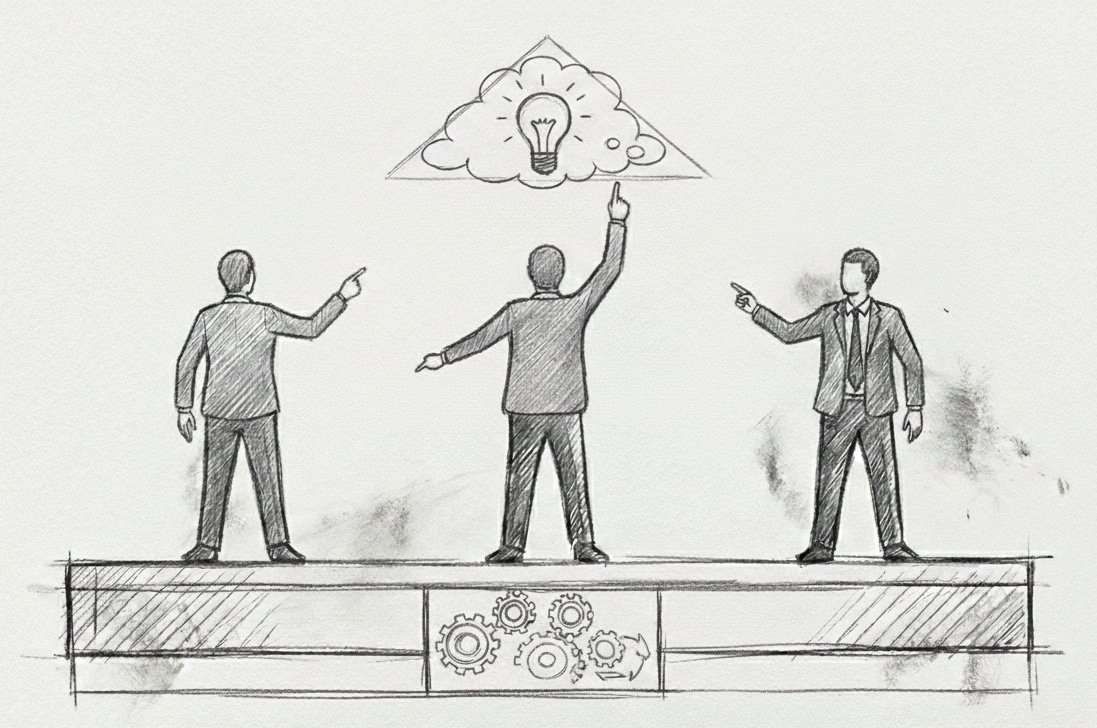
This problem becomes even more pronounced in times of technological disruption. AI is a clear and current example.
Who is best placed to understand which AI investments will actually pay off? It requires someone with a deep grasp of technical realities and a strong understanding of high-level business priorities. That intersection is precisely where middle management operates.
Yet, over-involvement of senior leadership in AI investment decisions is one of the major reasons many AI initiatives are failing. When the AI wave hit, what did many companies do? They laid off middle managers — the very people most capable of identifying where and how AI could be effectively leveraged. It is no surprise that we are now seeing a wave of re-hiring.
Consider Klarna, the fintech “buy now, pay later” company. In 2022, CEO Sebastian Siemiatkowski unilaterally decided to lay off 700 employees and replace parts of the organization with AI. As customer satisfaction declined sharply, he later admitted that the company had gone “too far” with AI.
This is not an isolated incident. An MIT report suggests that nearly 95% of generative AI pilots at companies are failing. In many cases, this reflects leadership pushing AI projects into areas where middle managers — had they been empowered to speak candidly — would have flagged a high likelihood of failure.
Middle managers who bring a healthy dose of skepticism and have the courage to question leadership initiatives are exactly the people who could have prevented many of these misinvestments. Ironically, these are often the first roles eliminated during post-pandemic layoffs.
The Solution: Empowered Middle Managers as Change Agents
Organizational change is hard. Sustainable change, especially in complex tech organizations, must be driven by people in the middle — those who understand both the strategic context and the operational realities.
Effective middle managers combine big-picture thinking with attention to detail. They adapt quickly to changing trends, challenge existing assumptions, and translate abstract strategy into day-to-day execution. Without this layer functioning well, even the strongest leadership vision remains theoretical.
Middle Management Hiring Mistakes
Most organizations rely primarily on internal promotions to fill middle management roles. This is often the wrong approach.
If middle managers are expected to drive meaningful change, they must bring fresh perspectives and new ways of working. That often requires hiring from outside — people who have seen different organizational models, industries, and cultures.
Adaptability matters more than deep specialization at this level. Strong middle managers tend to be generalists who have operated across functions or companies, and who can connect dots others miss.
Finally, effective middle managers must be strategic operators. They should focus on sense-making, prioritization, and decision-making, while relying on a strong layer of frontline managers for detailed execution.
Conclusion
When middle management is ignored, underpowered, or systematically removed, organizations do not become flatter or faster — they become weaker. In an era defined by rapid technological change and constant disruption, companies cannot afford to sideline the very people who connect strategy with execution. Empowered, respected, and well-chosen middle managers are not a cost to be minimized; they are a strategic advantage to be cultivated.
About the Author
Teja Vepakomma is a Product Strategy and Growth consultant to companies. He has many years of experience working in Product Management leadership roles in Global SAAS companies. He’s currently based in Bangalore, India. You can follow or reach out to him on LinkedIn.
Nice article. I can't agree more that no meaningful change can be implemented in large organizations without empowering middle management. Years of tribal knowledge, experience of handling the most unique problems, leveraging informal networks to cut through bureaucracy and ability to anticipate issues three steps ahead - these are all very valuable things that middle management brings to the table.
Speaking from my recent experiences, I do feel that many middle managers get too tactical, failing to see the broader organization/industry beyond their operation siloes. Their job demands elimination of risk which is what makes them excellent operators. However, this exact trait makes them risk averse, resistant to change and can slow down progress. Too often, the conversations turn into "How do we continue supporting X?" when the conversation should be "Does supporting X really add value", or "Will it be necessary to support X after we implement the new solution?".
Leading the organization through a technological disruption like AI requires effective risk management instead of risk elimination. The mindset needs to shift from deterministic outcomes to probabilistic outcomes - how to evaluate risk v/s reward, opportunities v/s tradeoffs and being comfortable with ambiguity/unknowns. In large organizations, it is more important than ever to facilitate collaboration and interaction between middle managers from different functions/business units. Bringing diverse set of middle managers in one room can help achieve strategic alignment, improve structural empathy, un-burden executive leadership from managing organizational politics.
The leadership in my company has identified the above issues and taken some positive steps but needs to pull one more critical lever - empowering middle management with autonomy to take critical decisions.